How to check a medRxiv preprint against CONSORT or STROBE
Check your medRxiv preprint against CONSORT, STROBE or the guideline your study follows, before you submit it to a journal.
- medrxiv
- reporting-guidelines
- consort
- strobe
Shane Ehrhardt, Founder · October 17, 2026

Most clinical journals ask for a reporting checklist when you submit. A randomised trial needs CONSORT. An observational study needs STROBE. Editors look at the checklist early, and missing items stand out. You can check your medRxiv preprint against its guideline from your Author Area, before you submit.
Why do journals ask for a checklist?
A reporting guideline lists what a reader needs to judge a study. For example: how participants were chosen, what was measured and when, and how missing data was handled. Each item asks one question: does the paper say what was done?
Most major medical journals require CONSORT for trials, and the ICMJE endorses it. Many journals want the completed checklist with page numbers. Most epidemiology and general medical journals ask for STROBE for observational studies.
When you fill in the checklist, you often find an item with no page number to give.
An example: STROBE item 9
Item 9 asks you to:
Describe any efforts to address potential sources of bias
Many observational papers discuss bias in the limitations. Fewer say in Methods what they did about it. A check finds this gap.
von Elm E, Altman DG, Egger M, Pocock SJ, Gøtzsche PC, Vandenbroucke JP; STROBE Initiative. The Strengthening the Reporting of Observational Studies in Epidemiology (STROBE) statement: guidelines for reporting observational studies. strobe-statement.org. Free to use and reproduce, per the STROBE Initiative.
Which guideline applies to my study?
| Your study | Guideline | Items |
|---|---|---|
| A randomised trial | CONSORT 2025 | 30 |
| A trial protocol | SPIRIT 2025 | 34 |
| An observational study | STROBE 2007 | 22 |
| A systematic review or meta-analysis | PRISMA 2020 | 27 |
| A case report | CARE 2013 | 13 |
| A quality improvement study | SQUIRE 2.0 (2015) | 18 |
| An economic evaluation | CHEERS 2022 | 28 |
Watch for these points:
- CONSORT is for the completed trial. This includes parallel group, crossover, cluster and factorial designs. A trial protocol uses SPIRIT.
- STROBE covers three designs: cohort, case-control and cross-sectional. Some items need a different answer for each design.
- SQUIRE is for quality improvement work in healthcare. Some items may not suit your paper, but the guideline expects you to consider each one.
- Items have sub-items. CONSORT 2025 has 30 items and 42 criteria. PRISMA 2020 has 27 items and 42 criteria. The check marks each criterion.
Two more guidelines are available: ARRIVE for animal studies and AGREE for clinical practice guidelines.
What does the check give me?
- A mark on each criterion: met, partly met, not met or not applicable.
- The passage behind each mark, quoted from your manuscript. If the mark is wrong, you can see why.
- What is missing, how to fix it and where it goes, for each criterion that falls short.
- Notes in the margin of your paper, beside the passages they are about.
- The marked checklist as a spreadsheet, to download.
An example: CONSORT 2025 item 14
Item 14 asks for:
Pre-specified primary and secondary outcomes, including the specific measurement variable (e.g., systolic blood pressure), analysis metric (e.g., change from baseline, final value, time to event), method of aggregation (e.g., median, proportion), and time point for each outcome
In a synthetic two-arm trial, the primary outcome states the measurement variable only. The secondary outcomes state none of the four parts. So the check marks the item partly met.
The check quotes both sentences from Methods. It says what to add for each outcome: the analysis metric, the method of aggregation and the time point. It also asks you to say which secondary outcomes the protocol pre-specified. This example uses no real manuscript.
Hopewell S, Chan AW, Collins GS, Hróbjartsson A, Moher D, Schulz KF, et al. CONSORT 2025 Statement: updated guideline for reporting randomised trials. BMJ. 2025;388:e081123. consort-spirit.org. CC BY 4.0.
How do I run a check from medRxiv?
- Post your preprint on medRxiv.
- Open your Author Area.
- Beside the manuscript, choose Submit Preprint to External Author Service.
- Choose Explore Science.
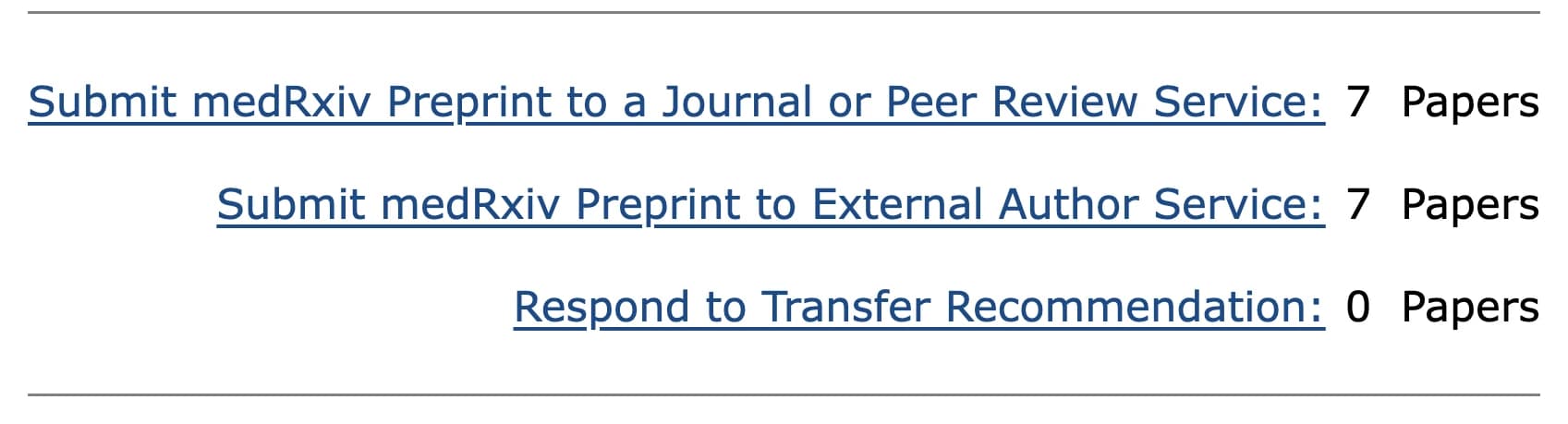
We get the manuscript and its author list from medRxiv, so you do not upload anything. You then get an email with a link. Sign in with your ORCID iD, or with a code sent to the email address on your submission. Then choose your guideline.
The first check is complimentary. The medRxiv integration page shows the steps on one screen.
What does the check not do?
A guideline check looks at reporting only. It asks if you state the time point of the primary outcome. It does not ask if that time point was the right choice. A trial can meet every CONSORT item and still be weak.
To assess the science, choose the full review. It reviews the methods, the analysis and the claims, and gives a Calibre score. Both are in the Author Area.
Common questions
Does the check replace the journal's checklist? No. The journal still wants its own form. The check shows which items fall short and quotes the passages for the rest. Use the spreadsheet to fill in the form.
Can anyone see the result on medRxiv? No. The result is private to you and the people you invite. Nothing goes back to medRxiv.
bioRxiv, medRxiv and openRxiv are trademarks of openRxiv, used with permission.